Cloud Foundation forms an ecosystem where many operational business aspects converge. At its core is the efficient use of hardware for compute, storage, and networking. Furthermore, VCF provides a single platform where both modern and traditional workloads can run side-by-side. And finally, security: because all traffic occurs within the VCF stack and is handled by the hypervisor, it is not only possible to gain visibility into traffic flows but also to protect traffic with firewall rules. With NSX and vDefend, a very powerful concept is created to protect all applications within it.
VMware Cloud Foundation 9.1
With the introduction of VMware Cloud Foundation 9.1, Broadcom demonstrates its strong commitment to the ongoing development of modern Private Cloud platforms. The latest version is now generally available and brings a range of innovations that give organizations greater control over automation, security, and running both traditional and cloud-native workloads. In this article, we share our perspective on VCF 9.1 from the viewpoint of a Cloud Service Provider.


Written by
Posted on
11
-
05
-
2026
2024
Written by
Posted on
11
-
05
-
2026
2024
From VCD to VCFA
Fundaments currently offers its Private Cloud services via VMware Cloud Director. With VMware Cloud Foundation, a new future-proof portal is being introduced: VCF Automation.
This portal contains many new features that provide greater insight into consumption, compliance, and security, as well as the automated deployment of workloads using application-as-code, including CI/CD pipelines, allowing organizations to easily consume all Private Cloud resources.
A benefit for our Private Cloud users is that, in addition to traditional virtual machines, cloud-native applications can be supported with Kubernetes (based on vSphere Kubernetes Service). Furthermore, thanks to the Supervisor concept, the platform is ready for AI-native workloads.

Supervisor ensures that the underlying vSphere resources can be utilized for many different components. Think of Kubernetes Clusters, Virtual Machines, Storage volumes, and advanced Load Balancing.
We are currently investigating how we can most easily facilitate the migration from Cloud Director to VCF Automation for our customers.
Under the hood: Memory Tiering and vSAN storage efficiency
New features have been delivered for Fundaments that allow us to further increase the efficiency of our hardware in the data centers.
Memory Tiering

In times of scarcity, particularly regarding DDR memory, it is essential to utilize all compute resources as effectively as possible. Broadcom has implemented the concept of Memory Tiering for this purpose. In this process, memory from servers and applications that is not being used ('not active memory') is written to a local NVMe disk, making more active memory available for a hypervisor. This allows us to achieve even higher densities, thereby mitigating the increasing costs of our physical servers.
vSAN ESA

With the introduction of VCF 9, a new version of vSAN has also been delivered: ESA (Express Storage Architecture). With the announcement of VCF 9.1, the efficiency of vSAN storage has increased further: an iteration has been made to the compression and deduplication properties of vSAN. In our own lab scenarios, we are seeing data reduction values approaching 2:1, whereas this was previously 1.3:1.
Version 9.1 also introduces AutoRaid on vSAN, a method for automatically placing workloads onto the appropriate storage profiles, ensuring that storage aligns optimally with required performance and redundancy.
Broadcom has also released research demonstrating that deploying vSAN ESA can reduce costs by up to 39% compared to traditional storage arrays.
Private AI ready
VCF 9.1 has further evolved in its ability to host AI workloads. This includes broader support for GPUs, particularly from the AMD portfolio, as well as the ability to live-migrate GPU-enabled workloads. This marks a new phase in GPU virtualization.
Additionally, support for various sources using the Model Context Protocol has been expanded. The announcement demonstrated how easily Google documents could be linked to an AI model for integration and processing.
These steps make it increasingly simple to offer an AI factory to our customers based on VCF, requiring less and less expertise to connect data from various sources.
SQL database as a service
With VCF 9.1, it is possible to deploy a database as a service using the VCF Automation platform, with support for SQL and PostgreSQL. Databases can be deployed via self-service, automatically scaled, backed up, and fully managed through automation.

Simplifying complex network management
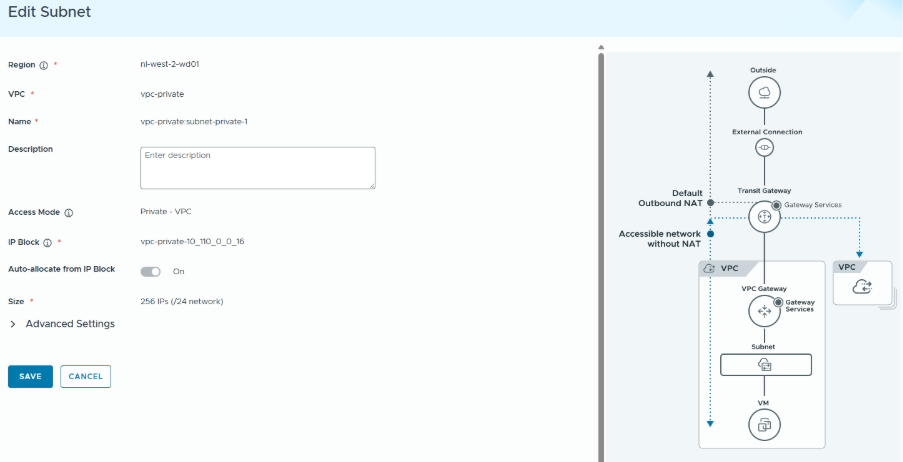
VCF 9.1 further expands the integration of network components with NSX. Complex network architectures can now be easily requested and even automatically deployed. All deployment steps are handled by the platform, presenting the ‘desired state’ to the user. Such concepts are vital for operating a software-defined datacenter.
We see that Broadcom is delivering on its promised development pace and realizing its roadmap. The vision of providing a complete, modern Private Cloud comes together in VCF 9.1
Would you like to learn more or see a demo of VCF 9.1? Please contact Arnoud.
